

ExxonMobil buys Denbury Resources for ~$5 billion to boost its carbon capture, utilization, and storage (CCUS) capacity and ramp up its low-carbon energy strategy.
Denbury Resources is an oil and gas producer, specializing in running an extensive CO2 pipeline transport network. It runs across the U.S. Gulf Coast, which includes major oil extraction facilities in Texas, Louisiana, and Mississippi.
Why Exxon Buys a Small-Scale Oil Business?
It’s all about carbon.
The major oil company’s move to acquire Denbury for $5 billion is for its existing CCUS infrastructure.
Carbon capture and storage is a booming industry that’s becoming more important in the US. Thanks to President Biden’s Inflation Reduction Act which provides tax credits for companies that operate it.
The infrastructure needed for CCUS on a large scale is expensive while building new pipelines is often opposed.
Thus, Denbury’s existing pipeline infrastructure stretching 1,300 miles is highly valuable. The small oil company has been using CO2 for enhanced oil recovery (EOR). This process injects the gas into oilfields to boost oil production.
Denbury is using carbon captured from industrial sources and injects 4 million tons of CO2 every year.
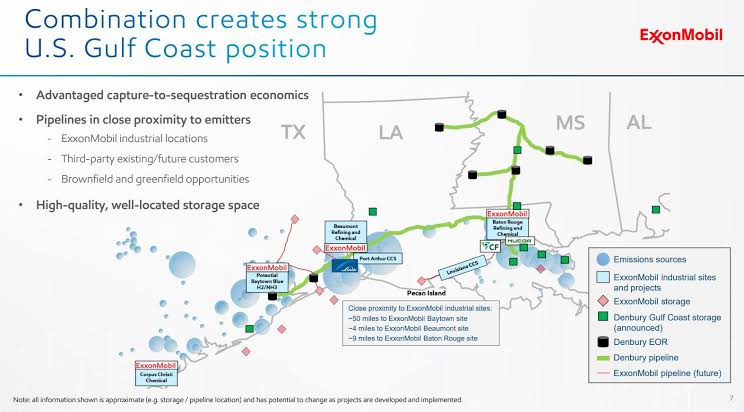
By buying Denbury, Exxon will own the largest operating carbon pipeline network in the country. The Gulf Coast region, in particular, is one of the biggest markets for CCUS in the U.S. Denbury also runs 10 onshore carbon sequestration sites represented in the following map.
Boosting Low-Carbon Energy Strategy
Exxon believes that its acquisition of Denbury will help in its lower-carbon energy strategy through a cost-effective CCUS system that it can integrate with its existing carbon solutions.
As shown in the map, the combined Exxon-Denbury system can potentially reduce CO2 emissions in the region by over 100 million metric tons per year.
The oil major considers CCUS a significant business, estimating that it will be a $4 trillion global market by 2050. This presents a multibillion-dollar income opportunity for Exxon and a revenue stream that will be more valuable and stable than oil and gas.
This strategy builds on the foundation of long-term contracts that can provide Exxon with a more predictable cash flow stream. The oil company had inked commercial deals to capture and sequester CO2 from various industrial polluters underpinning sequestration hubs it’s building on the Gulf Coast.
Over the past months, Exxon has partnered with fertilizer company CF Industries, steel manufacturer Nucor and gas producer Linde to capture CO2 from their factories, and transport and store it.
Integrating Denbury’s infrastructure will strengthen Exxon’s ability to capture more CCUS opportunities plus carbon credits.
Carbon capture and carbon credits have been the craze recently in an emerging carbon market. More and more companies are showing huge interest in the market as legislation accelerates worldwide.
Betting on the Carbon Credit Market
Buying Denbury will allow Exxon not only to deliver on its various CCUS deals but gives it a great potential revenue source as the carbon credit market matures.
While still in its early market stage, carbon credits enable companies and industries that can’t easily cut their carbon pollution to offset their carbon emissions.
Heavy emitters that have no viable alternatives to significantly reduce reliance on fossil fuels turn to carbon offset credits. The cash from the credits will fund or technically support carbon reduction projects and initiatives.
Each credit equals one tonne of carbon reduced or removed (with CCUS) from the atmosphere.
It’s not only Exxon that’s betting on carbon capture and the credits it generates. Other big oil companies are also putting their money into it such as Occidental, Chevron, and Shell.
There are also other carbon capture approaches designed to draw CO2 directly from the air instead of industrial plants. The captured CO2 is also transported toward its destination, either deep underground or for further application.
The CCUS, same with other carbon market segments, also comes with critics. Some think that the sector won’t be feasible while others believe it doesn’t cut dependence on fossil fuels.
Still, the upward trend and positive outlook of the market show that carbon credits serve a significant purpose in cutting down carbon emissions. Be it for providing alternatives to fossil fuel reliance or promoting sustainable business practices, the carbon credit market is projected to grow strongly.
Exxon’s $5 billion purchase of Denbury sees them placing a flag in the carbon market space. The strategic acquisition will allow the oil producer to scale up its low-carbon business. Their deal will close in the fourth quarter of this year.
Overall, Exxon plans to invest a total of $17 billion on low-carbon projects and cutting down its own carbon emissions.